


Page 1032 - Tungaloy Catalog
P. 1032
Technical Reference
                  Milling Tools
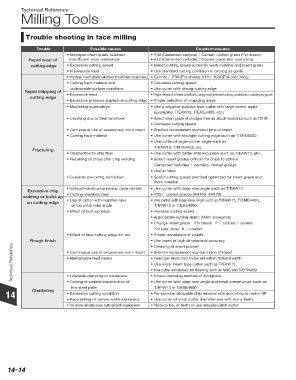
                    Trouble shooting in face milling


                        Trouble               Possible causes                             Countermeasures
                                      • Improper insert grade selection   • P30 (Cemented carbide) / Cermet, coated grade (For steels)
                     Rapid wear of      (Insufficient wear resistance)    • K10 (Cemented carbide) / Coated grade (For cast irons)
                      cutting edge    • Excessive cutting speed        • Select cutting speed suited for work material and insert grade
                                     • Inadequate feed                 • Use standard cutting condition in catalog as guide
                                     • Improper Insert grade selection (Insufficient toughness)   • Cermet / P30 (For steels), K10 / K20 (For cast irons)
                                     • Cutting hard material and       • Decrease cutting speed
                                        unfavorable surface condition    • Use cutter with strong cutting edge
                   Rapid chipping of
                     cutting edge    • Excessive feed                  • Proper selection of feed conditions, using recommended cutting conditions in catalog as guide
                                     • Excessive pressure applied on cutting edge   • Proper selection of engaging angle
                                     • Machining superalloys           • Use a negative-positive type cutter with large corner angle
                                                                          (Examples: T/EAW13, T/EME4400, etc.)
                                     • Cracking due to thermal shock    • Select insert grade of stronger thermal shock resistance such as T3130
                                                                       • Decrease cutting speed
                                     • Continuous use of excessively worn insert    • Shorten replacement standard time of insert
                                     • Cutting hard material           • Use cutter with stronger cutting edge such as T/ERD6000
                                                                       • Use cutter of larger corner angle such as
                                                                         T/EAW13, T/EME4400, etc.
                      Fracturing
                                     • Obstruction to chip flow        • Use cutter with better chip expulsion such as T/EAW13, etc.
                                     • Recutting of chips after chip welding   • Select insert grades difficult for chips to adhere
                                                                          Cemented carbides / cermets, coated grades
                                                                       • Use air blow
                                     • Excessively slow cutting, too fine feed    • Select cutting speed and feed optimized for insert grade and
                                                                           work material
                                     • Cutting soft material such as aluminum, copper, mild steel   • Use cutter with large rake angle such as T/EAW13
                    Excessive chip
                   welding or build-up    • Cutting stainless steel    • P30 / coated grades (AH140, AH120)
                    on cutting edge    • Use of cutter with negative rake   • Use cutter with large rake angle such as T/EAW13, T/EME4400,
                                          or too small rake angle         T/EPW13 or T/ESE4000
                                     • Effect of built-up edge         • Increase cutting speed
                                                                       • Appropriate cutting depth (finish allowance)
                                                                       • Change insert grade    For steels:  P / coated / cermet
                                                                          For cast irons:  K / coated
                                     • Effect of face cutting edge run out   • Proper installation of inserts
                     Rough finish                                      • Use insert of high dimensional accuracy
              Technical Reference    • Continuous use of excessively worn insert    • Shorten replacement standard time of insert

                                                                       • Cleaning of insert pocket
                                                                       • Feed per revolution to be set within flatland width
                                     • Remarkable feed marks
                                                                       • Use wiper insert type cutter such as T/EAW13

                                                                       • Use cutter exclusively for finishing such as NMS and S/EFP4000

                                     • Unstable clamping of workpiece
                                                                       • Use cutter with large rake angle and small corner angle such as
                                     • Cutting of welded construction of
                                                                          T/EPW13 or T/ESE4000
                                         thin steel plate              • Check clamping method of workpiece
                      Chattering
           14                        • Excessive cutting condition     • Re-examine allowable chip removal rate according to motor HP
                                     • Face milling of narrow width workpiece   • Use cutter of small cutter diameter and with many teeth
                                     • Too many simultaneous cutting teeth engagement   • Reduce No. of teeth or use irregular pitch cutter


            14–14

