


Page 46 - All Industrial Tool Supply | General Catalog
P. 46
END MILLS • Technical Information
          44


       Milling
       End mills resemble the look of drill bits but are used in a milling machine to remove material from a workpiece.
       Examples of this metal removal are slotting, grooving, profiling & plunge cutting.
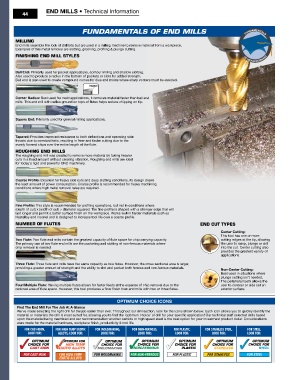
       finishing End Mill stylEs


       Ball end: Primarily used for pocket applications, contour milling and shallow slotting.
       Also used to produce a radius in the bottom of pockets or slots for added strength.
       Ball end is also used to create compound curves for dies and molds where sharp corners must be avoided.


       Corner Radius: Best used for mold applications, it removes material faster than ball end
       mills. This end mill with radius ground on tops of flutes helps reduce chipping on tip.


       square end: Primarily used for general milling applications.


       tapered: Provides improved resistance to both deflections and operating side
       thrusts due to constant helix, resulting in freer and faster cutting due to the
       evenly formed chips over the entire length of the flute.
       Roughing End Mills
       The roughing end mill was created to remove more material by taking heavier
       cuts in a fixed amount without creating vibration. Roughing end mills are ideal
       for today's rigid and powerful CNC machinery.


       Coarse profile: Excellent for heavy side cuts and deep slotting conditions, its design draws
       the least amount of power consumption. Coarse profile is recommended for heavy machining
       conditions where high metal removal rates are required.


       Fine profile: This style is recommended for profiling operations, but not in conditions where
       (depth of cut) x (width of cut) > diameter squared. The fine profile is shaped with a stronger edge that will
       last longer and permit a better surface finish on the workpiece. Works well in harder materials such as
       Hastelloy and Inconel and is designed to increase tool life over a coarse profile.
       nuMbER of flutEs                                                             End Cut typEs
                                                                                            Center Cutting:
                                                                                            This tool has one or more
       two Flute: Two flute end mills contain the greatest capacity of flute space for chip carrying capacity.     cutting edges at the tip, allowing
       The primary use of two flute end mills are the pocketing and slotting of non-ferrous materials where    the user to ramp, plunge or drill
       chip removal is needed.                                                              into the cut. Center cutting also
                                                                                            provides the greatest variety of
                                                                                            applications.

       three Flute: Three flute end mills have the same capacity as two flutes. However, the cross sectional area is larger,
       providing a greater amount of strength and the ability to slot and pocket both ferrous and non-ferrous materials.
                                                                                            non-Center Cutting:
                                                                                            Best used in situations where
                                                                                            plunge cutting isn't needed.
                                                                                            The peripheral teeth allows the
       Four/multiple Flute: Having multiple flutes allows for faster feeds at the expense of chip removal due to the    user to contour or side cut an
       reduced area of flute space. However, this tool produces a finer finish than end mills with two or three flutes.  exterior surface.
                                                 Optimum ChOiCe iCOns
        Find the end mill For the Job At A Glance
        We've made selecting the right drill for the job easier than ever. Throughout our drill section, look for the icons shown below. Each icon allows you to quickly identify the
        material or materials the drill is most suited for, allowing you to find the 'optimum choice' of drill for your specific application! Our technical staff selected drills based
        upon the material being machined and our recommendation whether carbide or high speed steel is the best option for your investment product dollar. Considerations
        were made for the material hardness, workpiece finish, productivity & tool life.

